Freight Forwarding Services: Everything Businesses Need to Know
International trade has transformed the way businesses source raw materials, distribute products, and expand into global markets. However, moving cargo across countries involves much more than simply booking a shipment. Documentation, customs regulations, carrier selection, transportation planning, warehousing, and final delivery all require professional coordination.
This is where freight forwarding services become essential.
A professional freight forwarding company acts as a logistics partner that manages every stage of cargo transportation, ensuring shipments move efficiently, safely, and in compliance with international trade regulations.
Whether your business ships full containers, less-than-container loads, oversized machinery, or urgent air cargo, working with an experienced freight forwarder helps reduce risks, optimize costs, and improve delivery performance.
What Are Freight Forwarding Services?
Freight forwarding services involve planning, organizing, and managing the movement of cargo from its origin to its final destination. Instead of transporting goods directly, freight forwarders coordinate the complete logistics process through shipping lines, airlines, trucking companies, customs authorities, warehouses, and distribution partners.
Their objective is to ensure cargo reaches its destination using the most efficient transportation method while maintaining regulatory compliance and minimizing delays.
Modern freight forwarding covers every stage of international logistics, including:
Cargo planning
Carrier selection
Documentation
Customs clearance
Ocean freight
Air freight
Land transportation
Warehousing
Cargo insurance
Final delivery
Why Freight Forwarding Services Are Important
International shipping involves multiple stakeholders, transportation modes, and government regulations. Managing every stage independently can lead to delays, higher costs, and compliance issues.
Professional freight forwarding companies simplify this process by coordinating every activity through a single logistics partner.
The advantages include:
- Reduced shipping costs
- Faster cargo movement
- Better route optimisation
- Professional customs documentation
- Lower operational risks
- Improved shipment visibility
- End-to-end logistics management
Businesses can focus on growth while logistics professionals manage transportation efficiently.
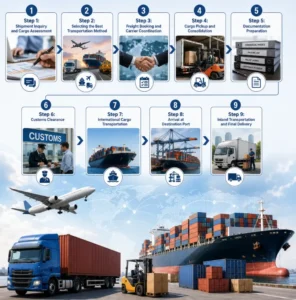
How Freight Forwarding Services Work
A structured freight forwarding process typically follows these steps:
1. Cargo Assessment
The shipment is evaluated based on:
- Weight
- Dimensions
- Cargo type
- Destination
- Delivery timeline
- Import or export requirements
This helps determine the most suitable transportation strategy.
2. Route Planning
Freight forwarders compare multiple transportation options to identify the most efficient route based on cost, transit time, and cargo requirements.
Depending on the shipment, transportation may involve:
- Ocean freight
- Air freight
- Road transportation
- Rail transportation
- Multimodal logistics
3. Documentation
International shipping requires accurate documentation, including:
- Commercial Invoice
- Packing List
- Bill of Lading
- Air Waybill
- Shipping Instructions
- Export Documentation
- Import Documentation
- Certificates of Origin
Proper documentation prevents customs delays and regulatory issues.
4. Customs Clearance
Every shipment must comply with import and export regulations.
Professional freight forwarders coordinate customs documentation, cargo classification, duty calculations, inspections, and customs approvals to ensure smooth border clearance.
5. Cargo Transportation
Once customs formalities are completed, cargo moves through the selected transportation network.
Shipments may involve:
- Full Container Load (FCL)
- Less than Container Load (LCL)
- Air Cargo
- Break Bulk Cargo
- Project Cargo
- Charter Services
6. Final Delivery
After arriving at the destination, cargo is delivered safely to warehouses, factories, retail locations, or project sites.
Types of Freight Forwarding Services
Freight forwarding companies provide specialized logistics solutions depending on cargo type and transportation requirements.
Ocean Freight
Ideal for large-volume international cargo transported through container shipping.
Suitable for:
- Industrial goods
- Manufacturing products
- Commercial cargo
- Bulk shipments
Air Freight
Air freight offers faster transportation for urgent, high-value, and time-sensitive shipments.
Common industries include:
- Pharmaceuticals
- Electronics
- Automotive
- Aerospace
- Medical Equipment
Land Transportation
Road transportation connects ports, warehouses, factories, and distribution centers for domestic and cross-border deliveries.
Multimodal Freight Solutions
Many international shipments combine multiple transportation modes such as sea, road, and air to improve efficiency while controlling costs.
Industries That Use Freight Forwarding Services
Freight forwarding supports almost every major industry, including:
- Manufacturing
- Engineering
- Automotive
- Pharmaceuticals
- Chemicals
- Renewable Energy
- Construction
- Oil & Gas
- Defence
- Retail
- E-commerce
- Food Processing
Each industry has unique logistics requirements that professional freight forwarders help manage effectively.
Choosing the Right Freight Forwarding Company
When selecting a logistics partner, businesses should evaluate:
- Industry experience
- Global logistics network
- Customs expertise
- Carrier relationships
- Shipment visibility
- Cargo handling capabilities
- Specialized transportation services
- Customer support
- Compliance knowledge
- End-to-end logistics capabilities
An experienced freight forwarding company provides far more than transportation—it becomes a long-term logistics partner.
Common Challenges in International Shipping
Businesses frequently encounter:
- Customs delays
- Documentation errors
- Port congestion
- Limited cargo space
- Rising freight costs
- Regulatory changes
- Shipment damage
- Route disruptions
Professional freight forwarding services help minimize these challenges through proactive planning and coordination.
Why Businesses Choose End-to-End Logistics Services
Managing multiple logistics providers can increase complexity.
End-to-end logistics services simplify operations by integrating:
- Freight Forwarding
- Customs Clearance
- Warehousing
- Cargo Consolidation
- Land Transportation
- Air Freight
- Ocean Freight
- Final Distribution
This integrated approach improves efficiency while reducing operational costs.
Why Choose Unicorn Shipping?
At Unicorn Shipping, we provide dependable freight forwarding services supported by an experienced logistics team and a strong global transportation network.
Our capabilities include:
- International Freight Forwarding
- NVOCC Services
- Customs Clearance
- Air Freight
- LCL Consolidation
- Land Transportation
- Break Bulk Cargo
- Project Cargo
- Warehousing & Distribution
- Ship & Aircraft Chartering
Every shipment is managed with precision, operational transparency, and a customer-focused approach to ensure timely and secure cargo movement.
Conclusion
Global trade depends on efficient logistics. Freight forwarding services provide the expertise, infrastructure, and coordination required to move cargo safely across international markets.
By partnering with an experienced freight forwarding company, businesses gain reliable transportation, customs expertise, optimised routing, and complete end-to-end logistics support—allowing them to focus on growth while ensuring every shipment reaches its destination efficiently.
Frequently Asked Questions
What is a freight forwarding service?
A freight forwarding service manages the planning, documentation, transportation, customs clearance, and delivery of cargo between countries.
What does a freight forwarder do?
A freight forwarder coordinates every stage of international cargo transportation by working with shipping lines, airlines, transport providers, warehouses, and customs authorities.
What industries use freight forwarding services?
Manufacturing, automotive, engineering, pharmaceuticals, retail, construction, energy, chemicals, and many other industries depend on freight forwarding for international trade.
What is multimodal freight transportation?
Multimodal freight transportation combines two or more transportation modes—such as sea, road, rail, or air—under a single logistics solution.
Why should businesses use freight forwarding services?
Freight forwarding services reduce shipping complexity, improve compliance, optimize transportation costs, and ensure smooth international cargo movement.