How to Choose a Logistics Company in India for International Cargo
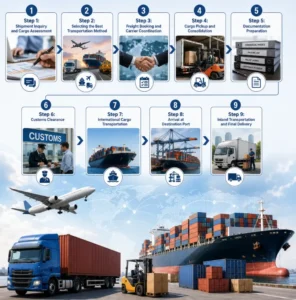
Choosing a logistics provider is an important decision for businesses involved in importing, exporting, manufacturing, distribution and international trade. A shipment may require much more than transportation between two locations. It can involve freight planning, carrier coordination, customs documentation, port handling, warehousing and final delivery.
The right logistics partner helps businesses coordinate these activities, understand shipment requirements and plan cargo movement around operational deadlines. However, logistics providers differ in their service capabilities, international networks, cargo-handling experience and ability to manage multiple stages of a shipment.
For businesses evaluating a logistics company in India, the decision should be based on the nature of the cargo, origin and destination, shipment frequency, delivery requirements and the level of coordination required.
This guide explains the factors businesses should evaluate before selecting a logistics partner for international cargo movement.
What Does a Logistics Company in India Do?
A logistics company coordinates the movement, handling, storage and delivery of goods across domestic or international supply chains. Depending on its capabilities, a provider may manage individual logistics activities or coordinate multiple services through one operational arrangement.
For international shipments, these activities can include:
- Freight planning and carrier coordination.
- Ocean freight and air freight arrangements.
- Container booking and cargo consolidation.
- Import and export customs clearance coordination.
- Shipping documentation and shipment information management.
- Road transportation between ports, warehouses and business locations.
- Warehousing and distribution support.
- Project cargo and specialised cargo handling.
The scope of service depends on the provider and the shipment requirements. Businesses should confirm which activities are handled directly, which are coordinated through partners, and who is responsible for communication at each stage.
For example, an exporter shipping industrial equipment overseas may need international freight arrangements, export documentation, port coordination and inland transportation. A business importing smaller consignments may require cargo consolidation, customs clearance coordination and delivery to its warehouse.
The logistics provider should be able to explain how these activities fit together before the shipment is booked.
7 Factors to Consider When Choosing a Logistics Company in India
1. Evaluate the Provider’s Freight Forwarding Capabilities
Freight forwarding is an important part of international cargo movement. A freight forwarder coordinates transportation arrangements with shipping lines, airlines, road transport operators and other logistics partners.
Before selecting a provider, assess whether it can support your shipping routes, cargo requirements and expected shipment frequency.
Consider the following questions:
- Can the provider arrange transportation to your required origin and destination?
- Does it handle both import and export shipments?
- Can it coordinate sea freight, air freight or multimodal transportation?
- Does it explain the expected transit schedule and the factors that may affect it?
- Can it provide shipment updates and communicate schedule changes?
Businesses that regularly import or export goods should also understand how the provider handles booking changes, delays, documentation issues and coordination between different transport operators.
Explore Freight Forwarding Services to understand how freight forwarding supports international cargo movement.
2. Select the Right Transportation Mode for Your Cargo
The most suitable transportation method depends on cargo volume, urgency, destination, handling requirements and overall shipping cost.
There is no single option that is best for every shipment. A logistics provider should explain the trade-offs before recommending a transport mode.
Transportation mode | Suitable requirements | Key consideration |
Ocean freight | Large commercial shipments, machinery and containerised cargo | Transit time, sailing schedules, port handling and container availability |
Air freight | Urgent, high-value or time-sensitive cargo | Chargeable weight, flight availability and handling requirements |
Road transportation | Domestic movement, port transfers and regional deliveries | Route planning, vehicle availability and delivery access |
Multimodal transportation | Shipments requiring two or more transport modes | Transfer coordination, documentation and schedule alignment |
For example, a shipment of industrial machinery may be more suitable for ocean freight when delivery urgency allows. A shipment of critical replacement components may require air freight to reduce transit time.
When comparing options, consider the full logistics requirement rather than looking only at the quoted freight rate.
Businesses with time-sensitive cargo can review Air Freight Services for information about air cargo transportation.
3. Check Customs Clearance and Documentation Support
International shipments require accurate documentation and compliance with the regulations applicable to the goods, countries and trade transaction.
Depending on the shipment, documents may include:
- Commercial invoice.
- Packing list.
- Bill of Lading for relevant ocean shipments.
- Air Waybill for air shipments.
- Shipping Bill for applicable Indian exports.
- Bill of Entry for applicable Indian imports.
- Certificate of Origin or other product-specific documents, where required.
The exact documents depend on the shipment, transaction, commodity and applicable regulations. A logistics provider should explain the documentation requirements and coordinate with the relevant parties, rather than assume every shipment follows the same process.
Businesses should also confirm how the provider handles document discrepancies, customs queries, inspection coordination and additional requirements for regulated goods.
Incorrect or incomplete documentation can result in delays, additional handling costs or compliance issues. Confirming responsibilities before shipment dispatch can reduce avoidable problems.
Learn more about Customs Clearance Services and the coordination involved in import and export cargo clearance.
4. Understand Container Shipping and Cargo Consolidation Options
Shipment volume has a direct influence on transportation planning. Businesses shipping full container loads may require container booking, sailing schedule coordination and container movement arrangements. Smaller shipments may be suitable for less-than-container-load consolidation.
Two common options are:
Full Container Load (FCL): The shipment uses an entire container allocated to that shipment. It may suit businesses with sufficient cargo volume or specific requirements for container use.
Less than Container Load (LCL): Cargo from different shipments is consolidated into shared container space. This can be useful when a business does not need an entire container, although consolidation, handling and destination charges must be considered.
The right option depends on cargo volume, dimensions, packaging, origin, destination, transit requirements and the total cost of moving the shipment.
A logistics provider should explain the relevant charges and handling arrangements so that businesses can compare options on a like-for-like basis.
For containerised cargo requirements, explore NVOCC Services. Businesses shipping smaller consignments can also review LCL consolidation services.
5. Assess Domestic Transportation and Warehousing Support
International transportation is only one part of the supply chain. Cargo may also need to move from a factory to a port, from an airport to a distribution facility, or from a customs-cleared location to the final delivery point.
If these activities are handled by separate providers, businesses may need to coordinate multiple schedules, documents and points of contact.
When evaluating a logistics company, ask whether it can coordinate:
- Cargo pickup from the supplier or manufacturing facility.
- Container or truck transportation to the port.
- Movement between ports, warehouses and distribution locations.
- Storage before dispatch or after arrival.
- Inventory handling and onward distribution, where required.
- Final delivery scheduling and proof of delivery.
Warehousing can be particularly relevant when shipment arrivals do not align with production schedules, inventory requirements or customer delivery dates.
Review land transportation services and warehousing and distribution services to assess the role of inland movement and storage in a coordinated logistics plan.
6. Compare Total Logistics Costs, Not Just Freight Rates
A low initial freight quote does not necessarily represent the lowest overall shipment cost.
Depending on the shipment, the total cost may include freight, documentation, customs-related charges, origin handling, destination handling, transportation, storage, consolidation and other applicable fees.
Before confirming a booking, request a quotation that clearly identifies the services included and any charges that may arise separately.
Use the following checklist when comparing quotations:
- Is the origin and destination scope clearly specified?
- Does the quotation identify the transportation mode and service level?
- Are origin and destination charges explained?
- Are customs clearance and inland transportation included or quoted separately?
- Are storage, inspection, demurrage or detention risks explained where relevant?
- Is the quoted rate valid for the expected booking period?
- Are exclusions, assumptions and payment terms clearly stated?
Not every charge can be confirmed before a shipment is assessed. However, a transparent quotation should identify known costs, exclusions and circumstances that may result in additional charges.
Businesses should compare quotations with the same shipment details, service scope and delivery requirements. Otherwise, a lower price may simply reflect a narrower service.
7. Review Communication, Shipment Visibility and Exception Handling
Logistics involves multiple parties, and shipment schedules can change because of factors such as carrier adjustments, port congestion, weather, customs inspections and documentation discrepancies.
A logistics partner should explain how shipment information is communicated and who is responsible for resolving issues.
Before appointing a provider, clarify:
- Who is the primary contact for shipment updates?
- How are booking confirmations and schedule changes communicated?
- What information is provided when a shipment is delayed?
- Who coordinates with carriers, customs representatives and transport operators?
- How are missing documents or discrepancies escalated?
- What information is shared after delivery?
Businesses should not rely solely on general claims such as “real-time tracking” or “on-time delivery.” Ask what visibility is actually available for the chosen service and how exceptions are managed.
Clear communication helps purchasing, production, warehouse and sales teams make better decisions when shipment schedules change.
Why Integrated Logistics Coordination Matters
A shipment can involve several independent stages, but those stages are operationally connected. A delay in one activity can affect the next.
Consider a manufacturer exporting machinery from India. The shipment may require pickup from the factory, export documentation, container booking, transportation to the port, customs clearance and international ocean freight. Depending on the agreed scope, additional coordination may be needed at the destination.
If these activities are not aligned, a shipment may miss a planned sailing, incur storage costs or require changes to the delivery schedule.
An integrated logistics arrangement can help by establishing responsibilities, sharing shipment information and coordinating the sequence of activities. It does not eliminate every delay or guarantee a particular delivery date, but it can make the process easier to manage.
For businesses shipping oversized machinery or cargo with specialised handling requirements, Project Cargo Logistics may also be relevant.
Which Type of Logistics Provider Does Your Business Need?
The best fit depends on your shipment profile and the level of support required.
Business requirement | Capability to evaluate |
Regular international imports and exports | Freight forwarding and carrier coordination |
Full container shipments | Container booking and NVOCC capabilities |
Smaller consignments | LCL consolidation |
Urgent international deliveries | Air freight planning |
Cargo movement between ports and factories | Land transportation |
Storage and distribution requirements | Warehousing and distribution |
Oversized or heavy industrial equipment | Project cargo planning and specialised handling |
Import and export compliance support | Customs clearance coordination |
A business with occasional international shipments may need a focused service for a specific trade lane. A manufacturer with recurring shipments across multiple markets may benefit from a provider that can coordinate several logistics activities.
The objective is to match the provider’s actual capabilities with the operational requirements of the business—not simply to choose the company offering the longest service list.
Questions to Ask Before Appointing a Logistics Company
Before confirming a long-term logistics arrangement or booking a shipment, obtain clear answers to these questions:
Can you support our origin and destination?
Confirm the routes served, available transport options and any reliance on external partners.
What information do you need to provide a quotation?
Typically, the provider needs origin, destination, cargo description, dimensions, weight, volume, shipment date and any special handling requirements.
Which services are included in your quotation?
Clarify freight, documentation, customs coordination, inland transportation, warehousing and any excluded charges.
Who manages the shipment from booking to delivery?
Understand the responsibilities of the provider, carriers, customs representatives and other parties involved.
How will we receive shipment updates?
Ask about booking confirmations, milestone updates, schedule changes and escalation procedures.
What happens if a shipment is delayed?
Confirm how the provider communicates the issue, identifies available options and coordinates the next steps.
These questions help establish realistic expectations before the shipment enters the logistics network.
How Unicorn Shipping Supports International Cargo Movement
Unicorn Shipping India Pvt. Ltd. provides shipping and logistics services for businesses involved in international trade. Its service portfolio includes freight forwarding, NVOCC services, customs clearance, air freight, LCL consolidation, land transportation, warehousing, project cargo, break bulk cargo handling and ship and aircraft chartering.
These services support different stages of cargo movement, depending on the shipment’s requirements.
For businesses evaluating a logistics partner, the appropriate starting point is to identify the cargo type, origin and destination, expected shipment frequency, delivery requirements and any customs or handling considerations.
This information helps determine which services are relevant and what coordination is needed between transportation, documentation, handling and delivery.
To understand the company’s overall service offering, visit the Unicorn Shipping homepage. Businesses can then review the specific service pages relevant to their shipment before submitting an enquiry.
Conclusion
Choosing a logistics company in India requires more than comparing freight prices. Businesses should evaluate transportation capabilities, customs documentation support, cargo consolidation options, inland logistics, cost transparency and communication procedures.
The right provider should be able to explain the shipment process, clarify responsibilities and coordinate the services required for the cargo to move from origin to destination.
Before making a decision, compare providers using the same shipment details and service scope. This creates a more reliable basis for evaluating costs, operational suitability and the level of logistics support your business needs.
Frequently Asked Questions
What should businesses look for in a logistics company in India?
Businesses should assess route coverage, freight forwarding capabilities, customs documentation support, transportation options, cost transparency, shipment communication and experience handling their cargo type.
What is the difference between a logistics company and a freight forwarder?
A freight forwarder primarily arranges and coordinates cargo transportation through carriers and other service providers. A logistics company may offer a broader range of services, including transportation, warehousing, distribution and other supply chain activities. The exact scope varies by provider.
Which is better for international cargo: air freight or ocean freight?
Air freight is generally suitable when transit speed is a priority, while ocean freight is commonly used for larger or heavier commercial shipments. The choice depends on cargo characteristics, delivery requirements, route availability and total cost.
Why is customs clearance important in international shipping?
Customs clearance ensures that shipments meet applicable import or export requirements. Correct documentation, classification, declarations and compliance with relevant regulations help reduce the risk of delays and additional costs.
Can one logistics company coordinate multiple shipping services?
Yes. Depending on its service capabilities and partner network, a logistics company may coordinate freight forwarding, customs clearance, transportation, warehousing and other shipment-related services. Businesses should confirm the scope of responsibility for each service.
How can businesses compare logistics quotations accurately?
Provide every shortlisted provider with the same cargo details, origin, destination, shipment date and required services. Compare the complete quoted scope, exclusions, applicable additional charges and service conditions rather than considering only the headline freight rate.